From Syntagma to Kerameikos: A Walk Through the Layers of Central Athens.
Walking from Syntagma to Kerameikos is less about covering distance and more about watching Athens change around you. In a relatively short route, government buildings give way to shopping streets, markets, ancient sites, old commercial quarters and quieter archaeological edges. It is one of the easiest walks for understanding how different versions of Athens sit side by side.
Start at Syntagma
Begin at Syntagma Square. It is useful not because it is the most atmospheric place in Athens, but because it gives you a clear starting point in the modern city. Parliament, hotels, traffic, metro entrances and shopping streets all meet here.
Before heading west, notice the contrast between the formal scale of the square and the narrower streets you are about to enter. The walk becomes more interesting almost immediately once you leave the open space behind.
Down Ermou: the modern city in motion
From Syntagma, follow Ermou west. This is one of central Athens’ busiest pedestrian routes, and that is part of the point. Shops, street performers, commuters and visitors create a very different atmosphere from the quieter historic streets nearby.
Do not rush through it. Look upward as well as ahead. Older façades still appear above modern shopfronts, while small churches interrupt the commercial rhythm at street level.
The route shows one of Athens’ recurring patterns: different periods survive on top of one another rather than in separate districts.
Monastiraki: where the route opens up
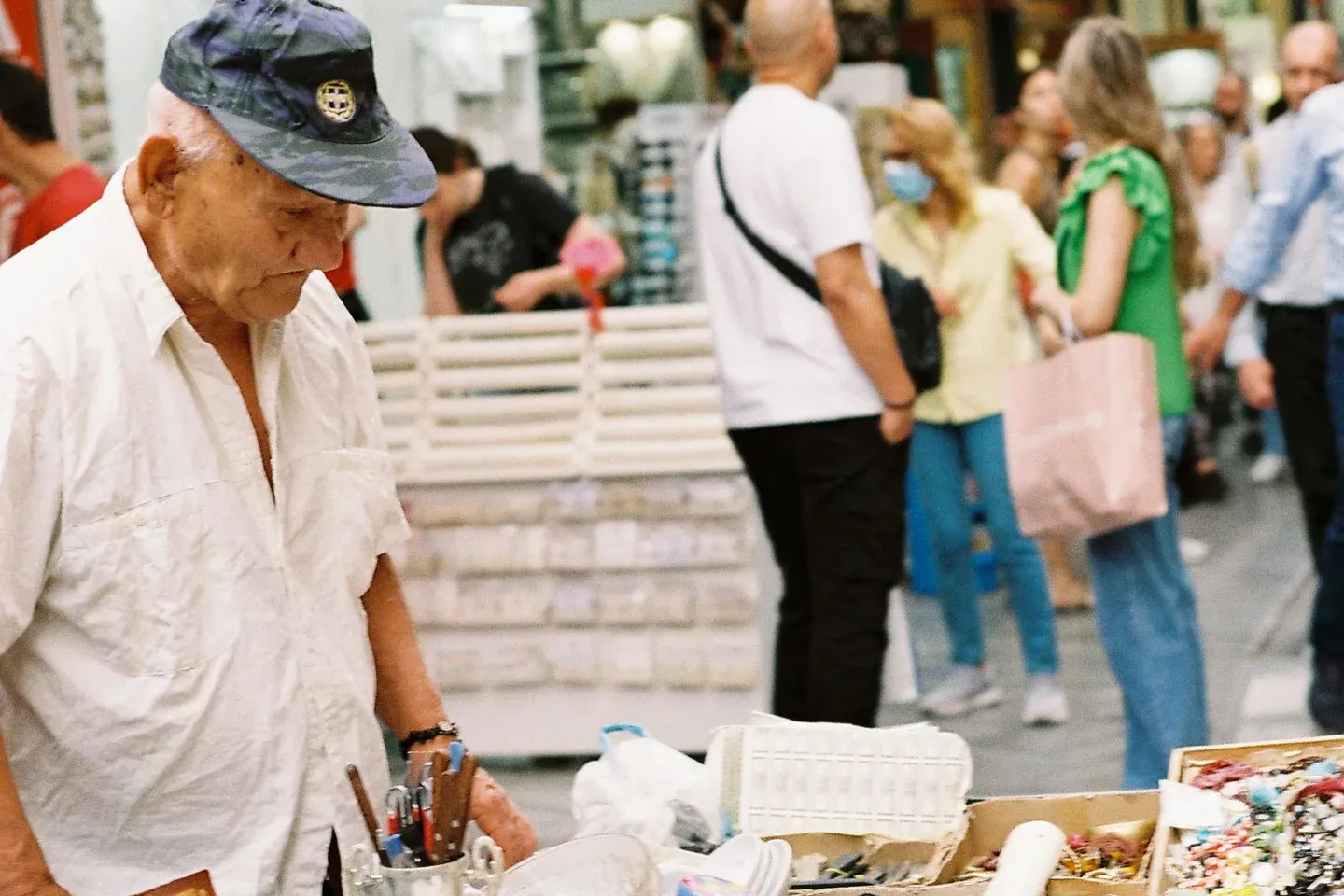
As you reach Monastiraki, the city changes again. The space becomes busier, noisier and visually more complicated. Metro lines, market streets, religious buildings, archaeological remains and heavy pedestrian traffic all converge around the square.
This is a good place to slow down. Instead of treating Monastiraki as a transfer point, look at how many different uses occupy the same small area. Commerce, transport, sightseeing and everyday movement all overlap.
Central Athens becomes easier to understand when you pay attention to the transitions between places, not only the places themselves.
From here, move toward the market streets and continue west rather than staying only around the square.
Along the edge of the Ancient Agora
The atmosphere begins to change once you leave the most crowded streets behind. The Ancient Agora sits close to the modern city, but the relationship between the two is what makes this part of the walk interesting.
On one side you have archaeological space and long historical perspective. On the other, cafés, shops, homes and streets continue with everyday life.
You do not need to enter the archaeological site for the contrast to make sense. Even walking along its edge helps you see how ancient Athens was absorbed into the modern city rather than separated from it completely.
Through Psyrri and Thissio
Depending on the exact streets you choose, you can move through parts of Psyrri before heading toward Thissio. Psyrri adds another layer: workshops, small businesses, cafés, bars and older commercial buildings coexist in a compact area.
Further south, Thissio feels more open. The pedestrian routes near the archaeological zone create more space, longer views and a different pace from the dense streets around Monastiraki.
This is where the walk starts to feel less commercial and more spatial. You begin to understand not just individual neighbourhoods, but how quickly the character of central Athens can change within a few hundred metres.
Finish at Kerameikos
Continue west toward Kerameikos. By the time you arrive, the city feels noticeably different from Syntagma.
The crowds are thinner. The urban fabric opens up. Archaeological space and the edges of older neighbourhoods become more visible. That contrast makes Kerameikos a strong place to finish.
The route has taken you from the formal centre of modern Athens, through shopping and market streets, past major historical layers and into a quieter part of the city.
The distance is manageable. The change in atmosphere is much larger.
Why is this walk useful for a first visit?
Because it connects several versions of Athens without requiring transport between them. You can see the modern centre, commercial Athens, historic neighbourhoods and archaeological space as one continuous urban story.
Practical notes for the walk
This is not a route that needs to be completed quickly. Allow roughly two to three hours if you want to stop, look around, take photographs or have coffee along the way.
Morning works well if you want cooler temperatures and quieter streets. Late afternoon gives the route more evening atmosphere, especially around Monastiraki and Thissio.
Wear comfortable shoes. The distance itself is not difficult, but pavements, pedestrian streets and uneven surfaces can vary.
Most importantly, do not follow the route as if every stop were an item to complete. The value is in noticing what changes between them.
- Start
- Syntagma Square
- Finish
- Kerameikos
- Time
- Around 2–3 hours at an unhurried pace
- Best for
- First-time visitors who want to understand central Athens on foot
- What to notice
- Changes in street width, commerce, architecture, crowd density and historical layers
Related Why Athens Looks the Way It Does: Ancient Ruins, Apartment Blocks and the Modern City
← PREVIOUS STORY
NEXT STORY →
Free guide · Athens Without the Tourist Traps
Arrive in Athens knowing what to expect.
A practical first-timer’s guide to fair prices, smarter sightseeing, transport, food and the common tourist traps worth knowing before you arrive.