Athens for First-Time Visitors: What to Know Before You Arrive
Athens is an easy city to enjoy once you understand a few practical details before you arrive. Transport is straightforward, the historic centre is compact, and many mistakes are avoidable with a little planning. The key is knowing where time, heat, tickets and tourist expectations can make the city feel harder than it really is.
Getting from the airport into the city
Most first-time visitors arrive through Athens International Airport. The simplest options are usually the metro, airport bus or taxi. Which one makes sense depends less on price alone and more on where you are staying, how much luggage you have and what time you arrive.
If your accommodation is close to a central metro stop, public transport can be straightforward. If you arrive late, are travelling with several people or have heavy luggage, a taxi may be worth the extra cost.
The important thing is to decide before you land rather than trying to work it out while tired at the arrivals hall.
How public transport actually works
Athens’ metro is usually the easiest way to move across the city. For most central sightseeing, however, you may use it less than expected.
Syntagma, Monastiraki, Plaka, Psyrri, Thissio and much of the historic centre are close enough to connect on foot. That makes the metro especially useful for longer jumps rather than every short journey.
Buy the correct ticket for your trip and validate it where required. Airport journeys use different fares from ordinary urban travel, so do not assume a standard city ticket covers everything.
The easiest way to move around central Athens is often a combination of metro for distance and walking for everything in between.
Acropolis tickets and timing
The Acropolis is the place where planning matters most. Do not assume you can arrive at any hour and have the same experience. Heat, queues and crowd levels can change the visit dramatically.
Earlier in the day is often easier, especially in warmer months. Late afternoon can also be pleasant, depending on season and closing time.
Use official ticket channels and check current entry arrangements before your visit. Ticket systems, time slots and opening hours can change, so this is one part of the trip worth confirming close to your travel date.
Walking, heat and distances
Athens looks compact on a map, but walking conditions matter. The historic centre is highly walkable, yet pavements can be uneven, streets can be steep and shade is not always available. In hot weather, a distance that feels easy in spring can feel completely different at midday in July or August.
Plan the most exposed parts of your day for earlier or later hours. Keep water with you and avoid building an itinerary that assumes you can walk continuously from one major site to another without breaks.
A slower schedule usually lets you see more, not less.
Taxis, cards and paying
Athens taxis are easy to recognise by their yellow colour and can be useful when public transport is inconvenient. As with any large city, it is better to know roughly where you are going and what kind of journey you are taking before getting in.
Card acceptance is widespread across Athens, particularly in hotels, restaurants, larger shops and organised attractions. Still, carrying a small amount of cash can be useful for minor purchases or situations where payment systems are temporarily unavailable.

Restaurants, prices and tourist traps
Central Athens contains excellent food, average food and places built almost entirely around passing tourist traffic. Location alone does not tell you which is which. A restaurant near a famous site is not automatically bad, and a place hidden in a side street is not automatically good.
Look at the menu, what people around you are ordering and whether the restaurant seems built for repeat business rather than one-time visitors. Be cautious when staff aggressively try to pull you inside, when menus are excessively long, or when prices and charges are unclear.
Do you need to avoid tourist areas completely?
No. Some very good places operate in busy central areas. The better approach is to judge the restaurant itself rather than assuming that “touristy” and “bad” always mean the same thing.
What to book in advance
You do not need to pre-book every part of an Athens trip. Prioritise the experiences where capacity, time slots or demand can genuinely affect your plans. Major archaeological sites, popular guided tours and limited-capacity experiences are the obvious candidates.
For everything else, some flexibility is useful. Athens rewards spontaneous stops: a café, a market street, a neighbourhood detour or a meal you did not plan two months earlier.
A better first-day strategy
Do less than you think you should. After arrival, use your first few hours to understand the centre rather than racing through major attractions.
Walk between Syntagma, Plaka and Monastiraki. Learn where the metro entrances are. Notice the distances. Sit down for coffee. Work out how the city connects. That orientation will make the next two or three days much easier.
The biggest first-time mistake is not missing one attraction. It is trying to understand Athens while moving through it too quickly.
- Airport to centre
- Choose metro, bus or taxi based on location, luggage and arrival time.
- Getting around
- Use the metro for longer distances and walk through the compact historic centre.
- Acropolis
- Check official tickets, entry arrangements and opening hours before visiting.
- Heat
- Plan exposed walking for cooler parts of the day.
- Payments
- Cards are widely accepted, but a small amount of cash is useful.
- First day
- Use it to understand the city rather than trying to see everything.
Related How to Read an Athenian Taverna: What to Order, When to Go and What to Avoid
← PREVIOUS STORY
NEXT STORY →
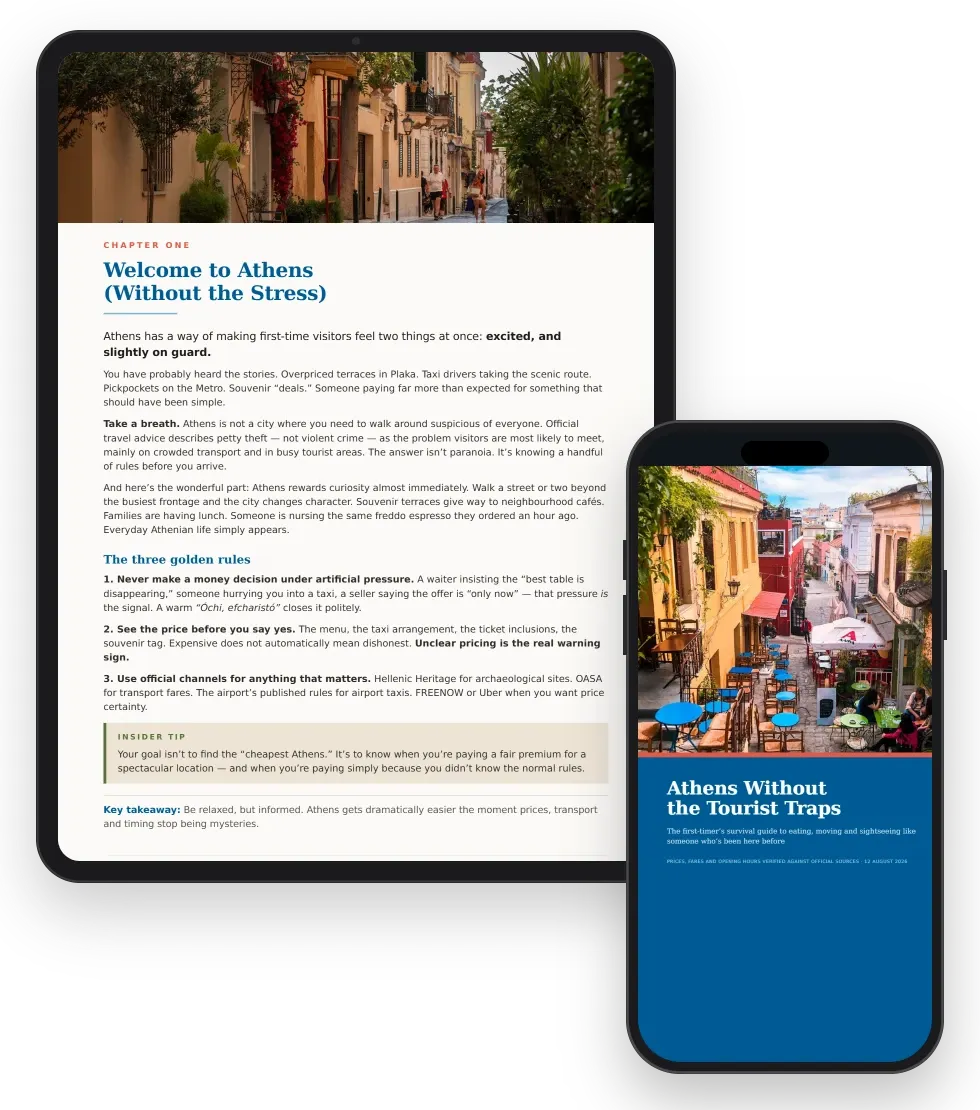
Free guide · Athens Without the Tourist Traps
Arrive in Athens knowing what to expect.
A practical first-timer’s guide to fair prices, smarter sightseeing, transport, food and the common tourist traps worth knowing before you arrive.