Why Athens Looks the Way It Does: Ancient Ruins, Apartment Blocks and the Modern City
Athens can feel visually confusing at first. Ancient remains sit beside apartment blocks, neoclassical houses survive between concrete façades, and one street can look completely different from the next. The city becomes easier to understand once you stop expecting one architectural identity and start seeing Athens as a series of layers.
Athens is a city of layers
Athens is not a city where the old centre ends and the modern city begins. Its different periods constantly overlap.
You can pass a Byzantine church, a nineteenth-century house and a post-war apartment block within a few minutes. Archaeological remains appear beside roads, shops and metro stations. A quiet residential street can suddenly open onto a major ancient site.
That mixture reflects the way Athens developed. When the city became the capital of modern Greece in the nineteenth century, it was still relatively small. Over the following decades it expanded rapidly around a place that already carried thousands of years of history.
The result is a city where the past rarely appears in one continuous architectural scene. Instead, it survives in fragments.
Why so much of Athens looks twentieth-century
Athens may be ancient, but much of the city you see today is relatively modern. During the nineteenth and early twentieth centuries, neoclassical buildings became an important part of the new capital. Many examples still survive, especially in parts of the historic centre.
But the transformation that shaped most of modern Athens came after the Second World War. The population grew quickly and demand for housing increased dramatically. The city needed homes, and it needed them fast.
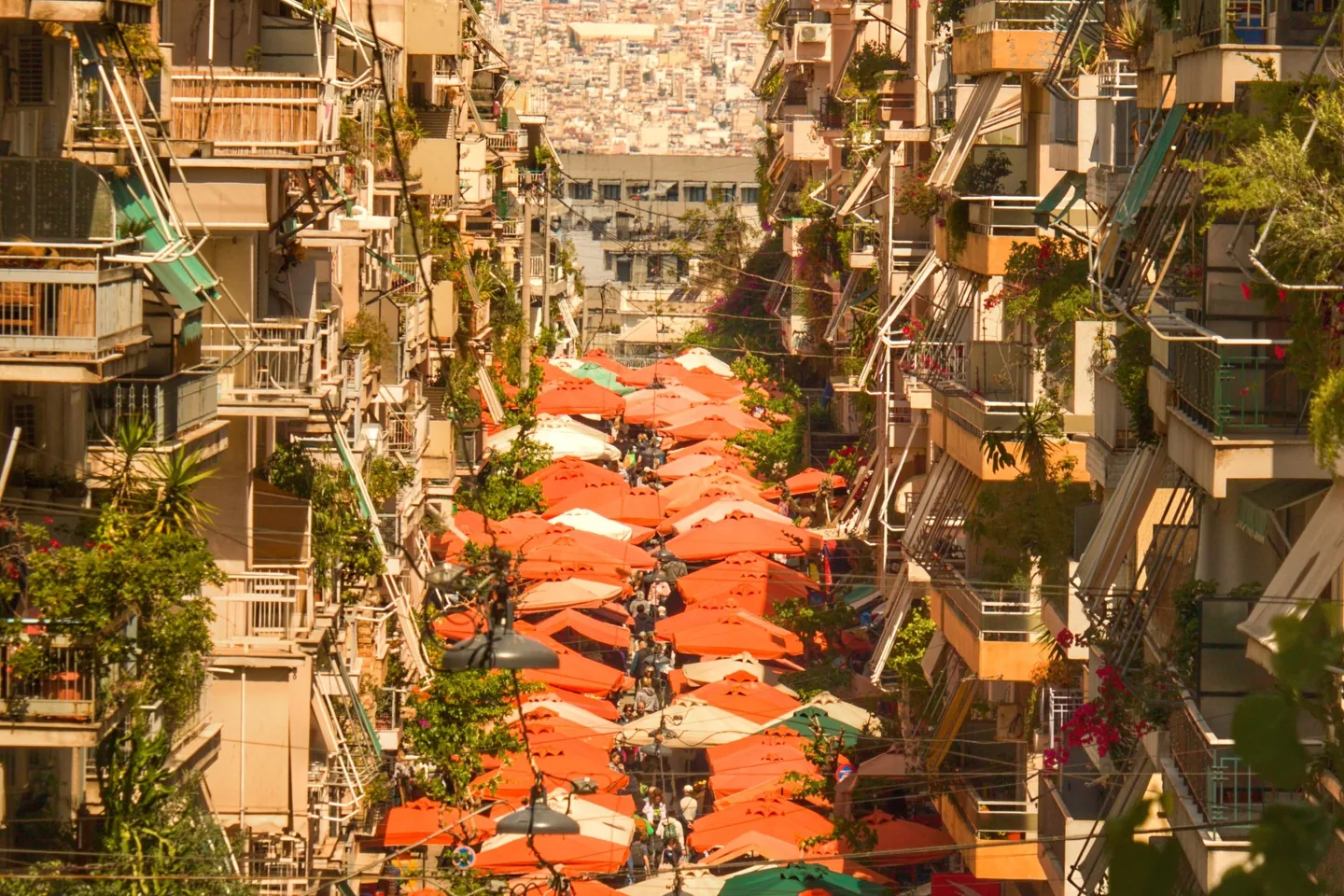
Older houses were replaced by larger apartment buildings. Streets that had once been lined with low-rise homes became much denser, while the street network itself often remained relatively narrow. Within a few decades, the familiar image of modern Athens had emerged: balconies, awnings, ground-floor shops, flat rooftops, solar heaters and rows of multi-storey apartment buildings.
The rise of the polykatoikia
The building that explains modern Athens better than almost any other is the polykatoikia — the multi-storey apartment block. Its rapid spread was closely linked to the post-war housing boom and to a development system known as antiparochi.
In simple terms, a landowner could give a developer the right to build on a plot. Instead of receiving only cash, the owner would receive some of the apartments in the new building, while the developer would sell the rest. This made it possible to rebuild the city plot by plot without requiring every landowner to finance construction directly.
The result was enormous. Thousands of small properties were gradually replaced by apartment buildings, changing both the density and the appearance of Athens.
To understand modern Athens, look beyond individual buildings. Much of the city was rebuilt one plot and one apartment block at a time.
The polykatoikia may seem repetitive from a distance, but at street level the differences become clearer. Balcony shapes change. Awnings add colour. Plants turn façades into vertical gardens. Ground floors become cafés, bakeries, workshops, pharmacies and small shops.
The basic structure may be similar, but decades of daily life have made each building slightly different.
Why old houses survive unevenly
Once you understand how redevelopment happened, another feature of Athens becomes easier to explain. Why does one street contain several old houses while another nearby street has almost none? Because redevelopment did not happen everywhere at once.
Some properties were rebuilt, others were not. Certain buildings were protected. Some areas retained stronger historic character, while others changed more dramatically. That is why Athens often feels inconsistent from block to block.
You might see a restored neoclassical house beside a 1960s apartment building, followed by an empty plot or a recent renovation. Rather than seeing these contrasts as visual noise, it helps to think of them as evidence of the city's development.
Why did Athens change so quickly?
Post-war population growth created intense demand for housing. Much of that demand was met through private, plot-by-plot construction, which transformed the city gradually but at remarkable speed.
How to read Athens while you walk
Once you know the basic story, the city becomes more interesting on foot. Start by looking up. Balconies are one of the strongest features of modern Athens. Notice their depth, the awnings, the plants and the way upper floors sometimes step back from the street.
Then look at ground level. Athens mixes homes with shops, cafés, offices and workshops. This helps explain why many neighbourhoods remain active throughout the day.
Pay attention to street width as well. Relatively narrow streets combined with multi-storey buildings create the dense urban feeling found across much of central Athens.
Most importantly, notice the interruptions. An old house between apartment blocks is not simply an exception. Neither is an archaeological fragment beside a modern pavement. They show you where one period of the city has survived inside another.
What this changes for a first-time visitor
Athens becomes much easier to appreciate once you stop expecting it to resemble a perfectly preserved historic city. Its interest comes from the opposite. Ancient remains, nineteenth-century architecture, post-war housing and contemporary life all occupy the same urban landscape.
Instead of asking only: Where are the beautiful old buildings? Try asking:
- Why does this street look the way it does?
- Why did one building survive while another disappeared?
- Why are shops built beneath apartments?
- Why does an ancient site appear in the middle of an otherwise modern neighbourhood?
Those questions change the way you experience Athens. The city stops looking inconsistent and starts becoming readable.
- Ancient city
- Archaeological layers remain embedded throughout the modern centre.
- 19th century
- Neoclassical architecture helped shape the new capital.
- Post-war growth
- Rapid population increase created huge demand for housing.
- Polykatoikia
- The apartment block became the defining building type of modern Athens.
- Antiparochi
- Private, plot-by-plot redevelopment transformed much of the city.
Related Plaka, Monastiraki and Psyrri: Three Neighbourhoods, Three Different Athenses
NEXT STORY →
Free guide · Athens Without the Tourist Traps
Arrive in Athens knowing what to expect.
A practical first-timer’s guide to fair prices, smarter sightseeing, transport, food and the common tourist traps worth knowing before you arrive.