How to Read an Athenian Taverna: What to Order, When to Go and What to Avoid
A good taverna in Athens is rarely about one “famous” dish. It is about how the menu is written, what is in season, how the table orders, and whether the place feels built for repeat customers rather than one-time visitors. Learn to read those signals, and eating in Athens becomes much easier.
A taverna is not just a menu
The first mistake many visitors make is treating a taverna like a restaurant where everyone orders one starter and one main course. Greek tavernas often work more loosely.
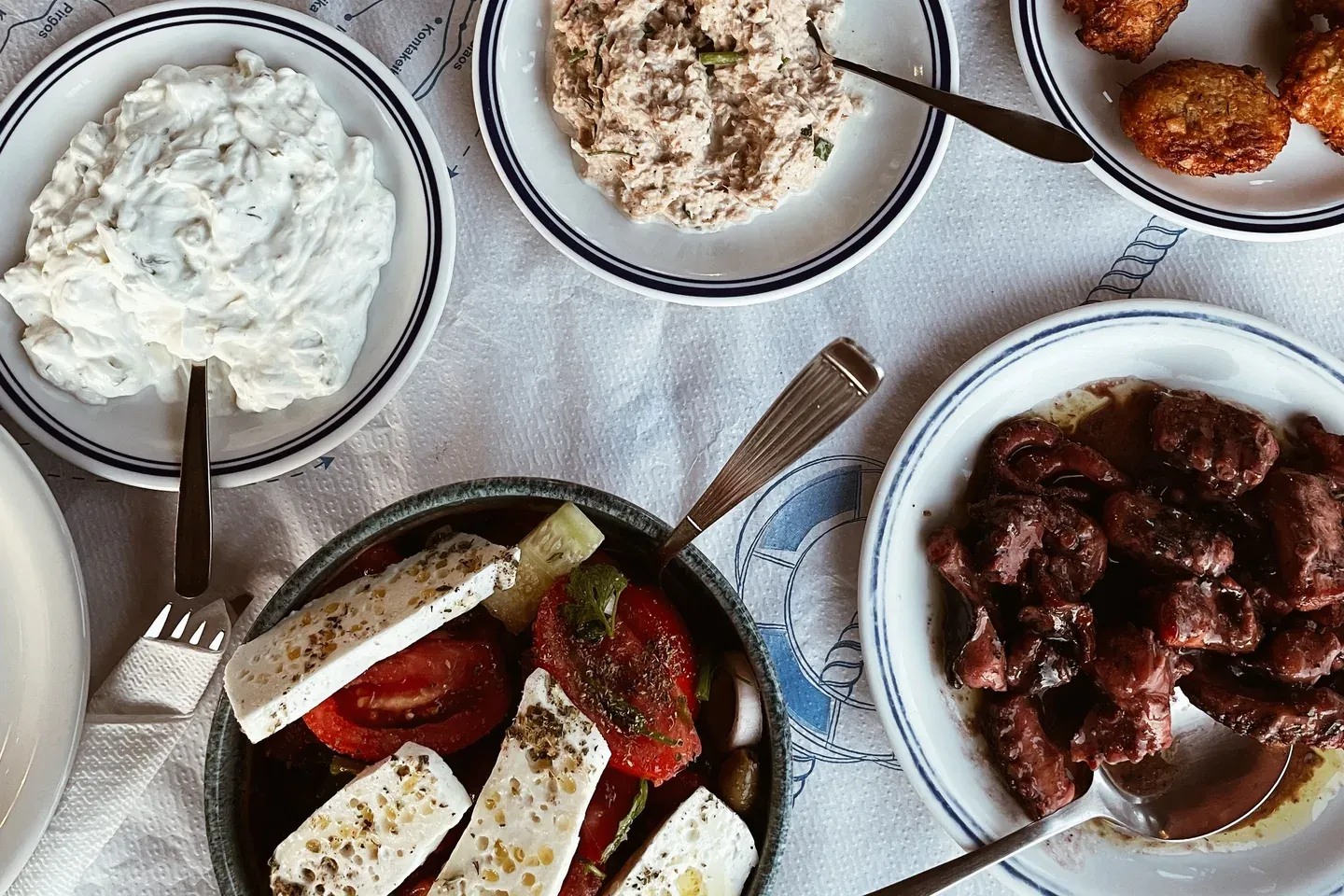
Dishes are commonly placed in the middle of the table and shared. One person may order grilled meat, another a vegetable dish, someone else a salad, and the table gradually becomes a meal rather than a sequence of individual plates.
That means the best question is not always: “What should I order?” It is: “What should we put on the table together?”
A simple meal of salad, one or two small plates, a cooked dish and something grilled can tell you more about a taverna than ordering the most expensive item on the menu.
Start with what is actually available
Menus in tourist areas can be long. That does not mean everything deserves equal attention. Ask what is fresh, what was cooked that day, or what the kitchen is known for.
Some dishes make more sense at certain times of year. Tomatoes, courgettes and aubergines are at their best in warmer months. Heavier baked or braised dishes feel more natural when the weather cools.
Look for dishes that sound ordinary rather than theatrical. Beans cooked in tomato sauce, stuffed vegetables, greens, baked aubergines, grilled sardines or a simple plate of meat can often tell you more about the kitchen than anything described as a “special Greek experience”.
A useful rule: if the menu is trying very hard to explain how authentic it is, keep reading carefully.
Meze, mains and how to order without overdoing it
One of the easiest ways to order badly in Athens is simply to order too much. Portions can be generous, and shared plates add up quickly.
For two people, a balanced order might be:
- one salad
- one or two small plates
- one vegetable or cooked dish
- one grilled or roasted dish
You can always add more. You do not need to order ten different meze just because they are listed under “starters”. Nor do you need a separate main course for every person.
In an Athenian taverna, the table matters more than the individual plate.
If you see something unfamiliar, ask how it is usually eaten and whether it is meant to be shared. That is often more useful than asking simply whether it is “good”.
When you eat matters
Athens runs later than many northern European cities. Lunch can stretch well into the afternoon, and dinner often begins later than visitors expect. A restaurant that looks quiet at 7:00 pm may be completely normal rather than unpopular.
If you prefer atmosphere, going a little later can help. If you prefer a calmer meal and more attentive service, arriving earlier can be useful. Timing also matters because some cooked dishes may be more commonly available at lunch, while grilled dishes and shared evening meals become more prominent later.
There is no single correct hour. The important thing is not to assume that an empty room at a northern-European dinner time means the place is bad.
Bread, water and the small details
The best clues are often the least dramatic. Bread may arrive automatically. Bottled or filtered water may be placed on the table without a long discussion. Some small items may appear as part of the normal service.
If you are unsure whether something is charged, ask. This is not about suspicion. It is simply easier to understand the bill when you know what has been placed on the table and why.
Also watch how the staff explain dishes. A good sign is when they tell you that something is finished, that a fish is sold by weight, or that you are ordering too much. That kind of honesty is usually more valuable than polished salesmanship.
How to spot a place built for repeat customers
Do not judge a taverna only by décor. Plastic chairs, paper tablecloths or a plain dining room tell you almost nothing about the quality of the food. Instead, look at the behaviour around you.
- Are people sharing dishes rather than photographing them for ten minutes?
- Are several tables ordering the same daily dishes?
- Do staff recognise regular customers?
- Does the menu focus on a manageable number of dishes rather than attempting to serve every Greek recipe ever invented?
A busy room can be a good sign, but popularity alone is not proof. Location matters too. A place beside a famous landmark can be full simply because thousands of people walk past it.
What does “local” really mean?
A useful taverna does not need to be unknown to visitors. What matters more is whether the kitchen appears designed for people who might return next week, not only for customers who will never come back.
What visitors often misunderstand
Greek food abroad can create expectations that do not always match everyday eating in Athens. Not every meal needs moussaka. Not every taverna specialises in souvlaki. And a long list of stereotypically Greek dishes is not necessarily a sign of quality.
It is also worth resisting the idea that there is one perfect “authentic” taverna. Athens contains old family tavernas, modern neighbourhood restaurants, seafood places, grill houses and kitchens focused on cooked dishes. They serve different purposes.
The better question is whether the place understands what it is trying to do — and does it well.
- Order for the table
- Shared dishes usually create a better meal.
- Ask what is fresh
- Daily and seasonal dishes are often worth attention.
- Start small
- You can always order more.
- Do not judge by décor
- Simple rooms can serve excellent food.
- Watch the regulars
- Repeat customers often reveal more than online hype.
- Notice honesty
- Staff who tell you when you are ordering too much are usually doing you a favour.
Related Why Athens Starts Late: Coffee, Dinner, Squares and the Rhythm of the City
← PREVIOUS STORY
NEXT STORY →
Free guide · Athens Without the Tourist Traps
Arrive in Athens knowing what to expect.
A practical first-timer’s guide to fair prices, smarter sightseeing, transport, food and the common tourist traps worth knowing before you arrive.